
16 Sep Rising Interest Rates and Retirement: What Retirees Should Know
What Do Rising Interest Rates Mean for Retirees and People Nearing Retirement?
Interest rates can feel like something that matters primarily to economists, banks, and the Federal Reserve.
But if you’re retired—or planning to retire within the next five years—changes in interest rates can reach surprisingly far into your financial life.
They can affect:
- What your cash may earn;
- The yields available on CDs and Treasury securities;
- The value and income potential of bonds;
- Mortgage and other borrowing costs;
- How you structure retirement income; and
- Potentially how much risk you need—or want—to take with different parts of your portfolio.
That doesn’t mean rising interest rates are automatically good or bad for retirees.
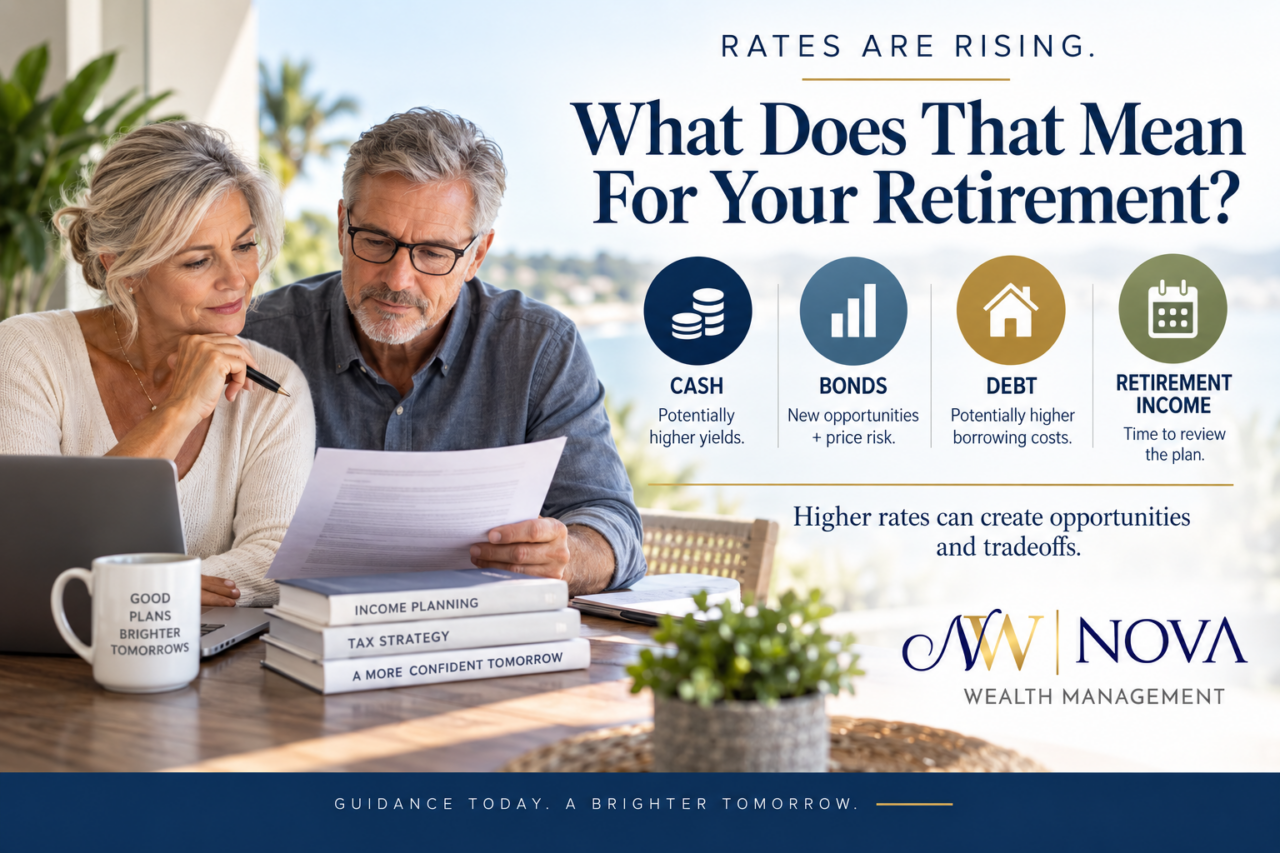
Higher interest rates can create both opportunities and risks in retirement. The important question isn’t simply whether rates are rising—it’s what higher rates mean for the different parts of your financial plan.
Why Are Interest Rates Important in Retirement Planning?
Interest rates influence both sides of a household’s financial life.
On one side, they can affect what savers and investors may earn on cash and fixed-income investments.
On the other, they can affect what borrowers pay for mortgages, home-equity lines, auto loans, business loans, and other forms of debt.
That interaction may become especially important around retirement.
Someone who is 30 and still accumulating assets may have decades before they need their investment portfolio to provide income.
Someone who plans to retire in two years may soon need to begin turning accumulated savings into a retirement paycheck.
The same interest-rate environment can therefore mean very different things depending on where you are in your financial life.
Are Interest Rates Actually Rising Right Now?
Interest rates don’t all move together, and “interest rates” can refer to several different things.
The Federal Reserve influences short-term rates through monetary policy, but Treasury yields, mortgage rates, savings rates, CD rates, corporate bond yields, and other borrowing and investment rates are also affected by market expectations, inflation, economic conditions, credit risk, and supply and demand.
As of mid-September 2026, the effective federal funds rate was 3.63%. At the same time, U.S. Treasury yields were higher farther along much of the yield curve, with the 1-year Treasury around 4.4%, the 5-year Treasury around 4.8%, and the 10-year Treasury around 5.0%.
Those rates can change quickly.
That’s why retirement planning shouldn’t be built around one day’s interest-rate quote—or a prediction about exactly what the Federal Reserve will do next.
The current rate environment matters. Your retirement plan needs to work after today’s rate environment changes, too.
How Do Higher Interest Rates Affect Cash and Savings?
One potential benefit of higher interest rates is that cash may be able to earn more than it did during very low-rate environments.
Depending on the institution, product, and current market conditions, higher rates may translate into more attractive yields on vehicles such as:
- High-yield savings accounts;
- Money market deposit accounts;
- Money market funds;
- Certificates of deposit;
- Short-term Treasury securities; and
- Other short-term fixed-income investments.
For retirees, that can be meaningful.
Cash may be used for upcoming expenses, emergency reserves, planned distributions, taxes, large purchases, or as part of a retirement-income strategy.
If money that needs to remain relatively liquid can earn a higher yield, that can improve the economics of maintaining those reserves.
But there’s an important distinction:
A better return on cash doesn’t automatically mean more of your retirement portfolio should become cash.
Should Retirees Keep More Money in Cash When Rates Are High?
Not necessarily.
Cash should generally have a purpose within the financial plan.
For example, a retiree might hold cash for:
- Emergency expenses;
- Near-term living expenses;
- Known large purchases;
- Upcoming tax payments; or
- A portion of planned portfolio withdrawals.
But money intended to support spending 10, 20, or 30 years into retirement has a different job.
Even when cash yields look attractive, long-term investors still need to consider inflation, taxes, reinvestment risk, and the potential opportunity cost of remaining out of other investments.
This is why asking, “How much is cash paying?” isn’t enough.
A better question is:
“What job does this money need to do, and when will I need it?”
How Do Rising Interest Rates Affect Bonds?
One of the most important concepts for retirees to understand is the relationship between market interest rates and existing fixed-rate bond prices.
When market interest rates rise, prices of existing fixed-rate bonds generally fall. When market interest rates fall, prices of existing fixed-rate bonds generally rise.
Why?
Imagine you own a bond paying 3% and newly issued bonds with similar characteristics become available paying 5%.
A new investor generally wouldn’t want to pay the same price for your 3% bond when a comparable new bond offers 5%.
The market price of the older bond may therefore decline to make it more competitive.
This is known as interest-rate risk.
Why Do Bond Prices Fall When Interest Rates Rise?
Consider a simplified example.
Suppose an investor owns a fixed-rate bond paying 3%.
Later, comparable newly issued bonds are available with higher yields.
The older bond’s payment hasn’t necessarily changed. What has changed is how attractive that payment looks compared with what’s now available in the market.
Its market price may therefore decline.
The reverse can also occur.
If newly issued comparable bonds begin paying less, an older bond with a higher fixed rate may become more attractive, potentially increasing its market value.
The amount a bond’s price responds to interest-rate changes can depend on several factors, including its maturity and coupon rate.
Longer-term bonds generally have greater sensitivity to changing interest rates than otherwise similar shorter-term bonds.
Can Higher Interest Rates Actually Be Good for Bond Investors?
Potentially, yes.
This is why it’s misleading to say rising rates are simply “bad for bonds.”
Higher rates may reduce the market value of some bonds that investors already own.
But higher rates may also allow new bonds to be issued at more attractive yields.
Investors may therefore have opportunities to reinvest maturing bonds or new money at higher yields than were available previously.
For retirees who use fixed income as part of an income or risk-management strategy, that can be meaningful.
Rising rates can hurt yesterday’s bond price while potentially improving tomorrow’s bond income opportunity.
Both sides of that equation matter.
Should Retirees Buy CDs or Treasuries When Rates Are Higher?
CDs and Treasury securities can both play a role in some retirement plans, but they’re not interchangeable and neither is automatically appropriate simply because yields are attractive.
A certificate of deposit is generally issued by a bank or credit union and may offer a fixed rate for a stated period. Applicable deposit insurance limits and rules should be considered.
U.S. Treasury securities are obligations of the federal government and include Treasury bills, notes, and bonds with different maturities.
When comparing alternatives, retirees may want to consider:
- Yield;
- Maturity;
- Liquidity;
- Whether funds may be needed before maturity;
- Credit characteristics;
- Deposit-insurance considerations where applicable;
- Federal and state tax treatment;
- Reinvestment risk; and
- How the investment fits into the broader retirement plan.
The highest quoted rate isn’t necessarily the best choice if the maturity doesn’t match when the money will be needed.
What Is a CD or Bond Ladder?
A ladder is a strategy that divides money among CDs or bonds with different maturity dates rather than investing the entire amount at one maturity.
For example, instead of putting all available fixed-income money into a five-year maturity, an investor might use several maturities spread across different years.
As each investment matures, the proceeds may become available for spending or may be reinvested at then-current rates.
A ladder can potentially help balance several competing goals:
- Generating income;
- Maintaining periodic access to principal;
- Avoiding the need to reinvest everything at one point in time; and
- Reducing dependence on correctly predicting the future direction of interest rates.
A ladder doesn’t eliminate investment risk, and the appropriate maturities depend on individual circumstances.
Should You Lock In Today’s Interest Rates?
That depends on what the money is for.
Locking in a longer-term rate may be attractive if it aligns with a future financial need.
But it also creates a tradeoff.
If market rates continue to rise, money locked into an earlier lower rate may not participate in those higher yields until it becomes available for reinvestment.
If rates decline, however, locking in today’s rate could look more attractive in hindsight.
The problem is that nobody knows with certainty which path rates will take.
That’s why maturity decisions should generally begin with the financial plan rather than an interest-rate forecast.
Instead of asking only, “Where are rates going?” ask, “When will I need this money?”
What Is Reinvestment Risk?
Reinvestment risk is the possibility that when an investment matures or generates cash flow, the proceeds may have to be reinvested at a lower interest rate.
Imagine a retiree buys a short-term CD because its current rate is attractive.
When the CD matures, interest rates may be lower.
The retiree can get the principal back, but they may not be able to find another comparable investment offering the same yield.
This is one reason the highest short-term yield isn’t the only consideration when building a retirement-income strategy.
Liquidity today and income needs tomorrow both matter.
What Do Higher Interest Rates Mean If You’re Retiring in the Next Five Years?
The five years before retirement can be an important transition period.
You’re moving from primarily accumulating assets toward preparing those assets to help fund your lifestyle.
That means your financial questions may begin to change.
Instead of only asking:
“How much can my portfolio grow?”
you may also need to ask:
“Where will my retirement income come from?”
That may involve coordinating:
- Social Security;
- Pensions;
- Cash reserves;
- Bond income and maturities;
- Investment-account withdrawals;
- Retirement-account distributions;
- Part-time income; and
- Other financial resources.
A higher-rate environment can create new possibilities within that plan, particularly for cash and fixed income.
But it doesn’t eliminate the need for long-term growth, diversification, tax planning, and liquidity.
How Do Higher Interest Rates Affect Your Retirement Paycheck?
A retirement paycheck may come from several sources rather than one employer.
For example:
Social Security + Pension Income + Interest and Dividends + Portfolio Withdrawals + Cash Reserves + Other Income = Your Retirement Paycheck
When interest rates are higher, some cash and fixed-income investments may generate more income than they would in a lower-rate environment.
That can change the role those assets play in the retirement-income plan.
But retirees should be careful not to assume today’s yields will remain available indefinitely.
A retirement could last several decades.
The retirement-income strategy therefore needs to consider both today’s opportunities and what happens when rates eventually change.
What Do Interest Rates Have to Do With Sequence-of-Returns Risk?
Sequence-of-returns risk is the risk that poor investment returns early in retirement, combined with portfolio withdrawals, can have an outsized effect on how long the portfolio lasts.
This becomes especially relevant as someone approaches the point when they will begin taking withdrawals.
A retiree who has an appropriate amount of near-term spending needs covered through cash, short-term fixed income, or other income sources may have more flexibility during a stock-market decline than someone who must sell investments immediately to fund expenses.
Higher yields on some lower-volatility assets may potentially provide additional tools when constructing that near-term retirement-income strategy.
But this doesn’t mean retirees should abandon stocks or long-term growth investments.
A retirement lasting 20 or 30 years may still require growth to help address inflation and future spending.
The goal isn’t necessarily to eliminate market risk. It’s to avoid asking every dollar in the portfolio to do the same job.
How Do Higher Interest Rates Affect Mortgages and Other Debt?
Higher interest rates aren’t only an investment issue.
They can also increase borrowing costs.
This can affect people nearing retirement who are considering:
- Buying a new home;
- Moving to a retirement property;
- Taking out a mortgage;
- Using a home-equity line of credit;
- Financing a vehicle;
- Borrowing for a business; or
- Carrying other variable-rate debt.
Higher borrowing costs can increase required monthly payments and potentially change retirement cash-flow projections.
Someone who developed a retirement plan assuming one mortgage payment may need to revisit the numbers if the cost of financing a planned home purchase has changed substantially.
This is another reason interest rates shouldn’t be viewed only through the investment portfolio.
Should You Pay Off Your Mortgage Before Retirement When Rates Are High?
There isn’t a universal answer.
Paying off a mortgage can reduce required monthly expenses and may provide psychological comfort.
But using a large amount of cash or investments to eliminate a mortgage can also reduce liquidity and potentially create tax consequences if retirement assets must be withdrawn to fund the payoff.
The mortgage’s interest rate also matters.
A homeowner with an older fixed-rate mortgage at a relatively low rate faces a very different decision from someone considering taking on new debt at a substantially higher rate.
Before paying off a mortgage, retirees may want to consider:
- The mortgage rate;
- Remaining loan term;
- Available cash;
- Emergency reserves;
- Investment assets;
- Tax consequences of raising the payoff funds;
- Monthly retirement cash flow; and
- Personal preferences around carrying debt.
“Should I retire without a mortgage?” and “Should I use my retirement assets to pay off my mortgage?” are not necessarily the same question.
Could Interest Rates Affect Roth Conversions or Tax Planning?
Interest rates don’t determine whether someone should complete a Roth conversion.
But changes in portfolio income and retirement cash flow can interact with tax-planning decisions.
For example, higher interest income from cash, CDs, bonds, or other taxable investments may increase taxable income.
That could potentially affect the amount of additional income someone wants to recognize through a Roth conversion in the same year.
Conversely, someone in the years between retirement and required minimum distributions may still have opportunities to evaluate partial Roth conversions as part of a multi-year tax strategy.
The key is coordination.
An investment decision can affect the tax plan, and the tax plan can affect the investment decision.
Roth conversions create taxable income and should be evaluated based on individual circumstances with appropriate tax and financial professionals.
Do Higher Interest Rates Mean You Should Change Your Investment Portfolio?
Not automatically.
A change in interest rates may justify reviewing the portfolio.
That’s different from assuming it requires an immediate change.
A portfolio should generally reflect factors such as:
- Your retirement timeline;
- Income needs;
- Risk tolerance;
- Liquidity needs;
- Tax situation;
- Other income sources;
- Time horizon; and
- Long-term financial goals.
If higher yields make certain fixed-income investments more attractive than they were previously, that may be relevant when rebalancing or investing new money.
But chasing whichever investment currently offers the highest yield can introduce new risks.
A higher yield can come with longer maturity, less liquidity, greater credit risk, or other tradeoffs.
Yield is one characteristic of an investment. It isn’t the entire investment decision.
Should You Wait for Interest Rates to Peak Before Investing?
Trying to identify the exact peak in interest rates requires predicting the future.
Even if you correctly anticipate the Federal Reserve’s next move, market interest rates may already reflect expectations about future policy.
Treasury yields, bond prices, mortgage rates, and other market rates can move before, during, or after Federal Reserve decisions.
That makes “I’ll invest when rates peak” difficult to execute consistently.
And waiting can have a cost.
Money sitting on the sidelines may miss investment opportunities while you wait for confirmation that may only become obvious after the fact.
Waiting for the perfect interest rate can become another form of market timing.
Rather than trying to predict one perfect entry point, some investors may use strategies such as diversification, staggered maturities, periodic investing, or rebalancing based on their financial plan.
What Should Retirees Review When Interest Rates Change?
A meaningful change in rates can be a good reason to review the financial plan without assuming that everything needs to change.
Consider reviewing:
- Cash: Is idle cash earning a competitive rate, and is the amount appropriate?
- CDs: Do maturity dates line up with expected spending needs?
- Bonds: What are the maturities, yields, credit characteristics, and interest-rate sensitivity?
- Bond funds: What role are they intended to play in the portfolio?
- Retirement income: Where will the first several years of retirement spending come from?
- Debt: Are any loans variable-rate, and are new borrowing plans still affordable?
- Taxes: Has increased interest income changed the tax projection?
- Portfolio allocation: Does the current mix still fit the retirement timeline and goals?
- Upcoming retirement: If retirement is within five years, has the income plan been tested under different market and interest-rate scenarios?
The objective isn’t to react to every move in rates.
It’s to make sure the financial plan still reflects the environment you’re actually living in.
Frequently Asked Questions About Interest Rates and Retirement
Are Rising Interest Rates Good or Bad for Retirees?
Rising interest rates can create both benefits and challenges for retirees. Higher rates may increase yields available on cash, CDs, Treasury securities, and newly issued bonds, while also reducing the market value of some existing fixed-rate bonds and increasing borrowing costs. The overall effect depends on a retiree’s investments, debt, income needs, and financial plan.
What Happens to Bonds When Interest Rates Rise?
When market interest rates rise, prices of existing fixed-rate bonds generally fall because newly issued comparable bonds may offer higher yields. Longer-maturity bonds are generally more sensitive to interest-rate changes than otherwise similar shorter-maturity bonds. Investors holding individual bonds to maturity may view interim price changes differently from investors who may need to sell before maturity.
Should Retirees Buy Bonds When Interest Rates Are High?
Higher yields can make some bonds more attractive for certain retirement strategies, but yield alone shouldn’t determine whether a bond is appropriate. Maturity, credit risk, liquidity, taxes, interest-rate sensitivity, income needs, and the bond’s role within the overall portfolio should also be considered.
Should Retirees Keep More Money in Cash When Interest Rates Rise?
Higher cash yields don’t automatically mean retirees should increase their cash allocation. The appropriate amount of cash depends on upcoming spending, emergency reserves, other income, investment strategy, taxes, inflation, and long-term goals. Cash intended for near-term needs has a different purpose from assets intended to fund decades of retirement.
Are CDs Good for Retirees When Interest Rates Are Higher?
CDs may be useful for some retirees seeking predictable interest and known maturity dates, but they also involve tradeoffs. Investors should consider maturity, liquidity, early-withdrawal provisions, applicable deposit-insurance limits, taxes, and the possibility that rates may be different when the CD matures.
Are Treasury Securities Good for Retirees?
U.S. Treasury securities may play a role in some retirement portfolios because they offer a range of maturities and are backed by the U.S. government for timely payment of principal and interest. However, Treasury securities can still experience price changes before maturity, and retirees should consider maturity, interest-rate risk, inflation, liquidity, and tax treatment when deciding whether they fit a particular plan.
Should I Lock In Interest Rates Before I Retire?
Whether to lock in a rate depends on when the money will be needed and the role it plays in the retirement plan. Locking in a longer-term rate may provide more predictability, but it may also limit the ability to reinvest at higher rates if rates continue rising. Staggering maturities may be one way to reduce dependence on a single interest-rate decision.
Do Higher Interest Rates Mean I Should Delay Retirement?
Not necessarily. Interest rates are only one part of retirement readiness. The decision to retire may depend on savings, spending, Social Security, pensions, portfolio sustainability, debt, healthcare, taxes, and personal goals. Higher borrowing costs or changes in expected investment income may justify updating the retirement projection, but they don’t automatically determine when someone should retire.
Should I Pay Off My Mortgage Before I Retire?
There is no universal answer. The mortgage rate, remaining term, monthly payment, available liquidity, tax consequences, investment assets, and personal comfort with debt all matter. Using retirement-account assets to pay off a mortgage may also create taxable income, so the source of the payoff funds should be considered alongside the debt itself.
What Should I Do With My Portfolio If Interest Rates Keep Rising?
A rising-rate environment may be a reason to review cash, fixed income, portfolio allocation, retirement income, and debt, but it doesn’t automatically require a portfolio change. Investment decisions should be based on the individual’s goals, time horizon, liquidity needs, risk tolerance, tax circumstances, and overall financial plan rather than a prediction about the next interest-rate move.
Don’t Build Your Retirement Around a Rate Prediction
It’s tempting to look at today’s rates and try to determine what comes next.
Will rates go higher?
Will the Federal Reserve cut?
Should you lock in a CD?
Should you wait to buy bonds?
Should you move more money into cash?
Those may all be reasonable questions.
But retirement planning shouldn’t require you to correctly predict interest rates.
A stronger approach is to determine what each part of your money needs to accomplish.
Money needed soon may need liquidity and stability.
Money intended to generate income may require a different strategy.
Money that won’t be needed for many years may still need long-term growth.
And debt needs to be evaluated based on its cost and its effect on retirement cash flow.
The question isn’t simply, “Where are interest rates going?”
The better question is, “Does my retirement plan still work if rates change?”
Are You Retiring Within the Next Five Years?
The years immediately before retirement are an opportunity to begin connecting your investments to the income they’ll eventually need to provide.
At Nova Wealth Management, we help individuals and families evaluate how cash, investments, fixed income, Social Security, taxes, debt, and portfolio withdrawals may work together as retirement approaches.
A changing interest-rate environment may create new opportunities, but those opportunities should be evaluated in the context of the entire financial plan.
If you’re retired or planning to retire within the next five years, this may be a good time to review whether your current strategy still fits the retirement you’re preparing for.
Schedule a Meeting with Nova Wealth Management.
Phone: (239) 444-1794 (Florida) or (214) 764-9137 (Dallas)
Sources: Board of Governors of the Federal Reserve System, H.15 Selected Interest Rates; U.S. Department of the Treasury, Daily Treasury Par Yield Curve Rates; U.S. Securities and Exchange Commission Office of Investor Education and Advocacy, investor education regarding fixed-income investments and interest-rate risk. Current interest-rate figures referenced in this article are as of September 2026 and will change over time.
Disclosure: Nova Wealth Management, Inc. is a Registered Investment Advisor. This material is provided for general educational and informational purposes only and is not intended as personalized investment, tax, or legal advice. References to bonds, Treasury securities, certificates of deposit, money market funds, cash accounts, or other investments are for educational purposes and should not be interpreted as recommendations to buy or sell any particular security or investment. Investments involve risk, including possible loss of principal. Bond and fixed-income investments are subject to risks that may include interest-rate risk, credit risk, inflation risk, liquidity risk, and reinvestment risk. Government backing of Treasury securities applies to the timely payment of principal and interest and does not prevent market-value fluctuations before maturity. Deposit insurance is subject to applicable eligibility requirements and limits. Tax treatment varies by investment and individual circumstances. Interest rates, yields, prices, and market conditions change over time. Financial decisions should be based on an individual’s unique circumstances, goals, time horizon, risk tolerance, liquidity needs, and tax situation.



No Comments