


25 Aug 2026 Year-End Tax Planning for Small Business Owners
2026 Year-End Tax Planning for Small Business Owners: What to Review Before December 31
For many small business owners, taxes become a priority sometime between January and April.
By then, however, an important part of the conversation may already be over.
Tax preparation looks backward. Tax planning looks forward.
When your tax professional prepares a return, much of the work involves reporting income, deductions, credits, payroll, business expenses, and other financial activity that has already occurred.
Year-end tax planning is different.
It asks what decisions may still be available while the tax year remains open—and how those decisions could affect not only your 2026 tax situation, but your business cash flow, retirement savings, personal finances, and longer-term goals.
That distinction is particularly important for business owners because business and personal finances frequently intersect.
Compensation decisions can affect retirement-plan contributions. Business purchases can affect cash reserves. Entity structure can affect how income is taxed. Charitable giving may interact with a broader tax strategy.
And sometimes a decision that reduces taxes today isn’t necessarily the decision that produces the strongest long-term financial outcome.
That’s why 2026 year-end tax planning for small business owners should be about more than finding deductions before December 31.
It should begin with understanding which decisions are still available—and whether they make sense within the larger financial picture.
Why Small Business Tax Planning Should Happen Before Tax Season
There’s a fundamental difference between asking:
“What deductions can I claim on my tax return?”
and asking:
“What financial decisions should I consider before the end of the year?”
The first question is largely about documenting and reporting what has already happened.
The second is about planning.
Some tax-related decisions must be made or implemented during the tax year. Others have different deadlines depending on the strategy, account, election, or taxpayer’s circumstances.
Waiting until tax-filing season can therefore mean discovering that an opportunity you wanted to consider is no longer available for the prior year.
That’s one reason August, September, October, and November can be valuable months for business owners to begin year-end planning.
There’s still time to estimate where the business may finish the year and coordinate with the appropriate tax, financial, payroll, and legal professionals when necessary.
Tax Planning vs. Tax Preparation: What’s the Difference?
These terms are sometimes used interchangeably, but they describe different activities.
Tax preparation generally involves assembling financial information and preparing the tax returns required to report a completed tax year.
Tax planning involves evaluating financial decisions before they’re made and considering their potential tax consequences.
For example, a tax preparer might report the retirement-plan contribution a business owner made during the year.
Tax planning may involve evaluating which retirement-plan structures are available, their contribution rules, their costs and administrative requirements, and how a particular plan could fit with the owner’s broader retirement strategy.
Preparation asks:
“What happened?”
Planning asks:
“What could we do next, and what are the potential consequences?”
Both are important.
But they aren’t the same service.
1. Review Your Business Structure and Tax Election
Your business structure can affect taxes, liability, administrative requirements, payroll, and how money moves between the business and its owners.
That’s why year-end can be a useful time to review whether the structure that made sense when the business began still makes sense today.
A business might operate as a sole proprietorship, partnership, limited liability company, corporation, or another structure depending on its circumstances.
One particularly important point is that an LLC is a legal business structure, not automatically a separate federal tax classification.
Depending on its ownership and elections, an LLC may be treated differently for federal income-tax purposes.
For example, an eligible business may potentially elect S-corporation taxation, but that doesn’t mean an S-corporation election is appropriate for every profitable business.
There can be additional payroll requirements, administrative costs, compensation considerations, tax consequences, and compliance responsibilities.
The question shouldn’t simply be:
“Would another entity structure lower my taxes?”
A better question may be:
“Does my current business and tax structure still make sense given my income, expenses, payroll, ownership, growth plans, retirement goals, and administrative needs?”
Don’t Assume an LLC Automatically Reduces Your Taxes
This is worth emphasizing because it’s a common source of confusion.
Simply forming an LLC doesn’t necessarily reduce federal income taxes.
The tax treatment depends on factors including the number of owners and any tax elections the business makes.
Likewise, choosing an entity or tax election solely because someone else said it saved their business money can be problematic.
Two businesses with similar revenue can have very different expenses, owner compensation, employees, retirement plans, cash-flow needs, and long-term objectives.
Entity selection should therefore generally involve both legal and tax considerations rather than being treated as a year-end tax trick.
2. Review Your Business Retirement Plan Before Year-End
For a business owner, a retirement plan can potentially serve two purposes at once:
- Help build assets for retirement; and
- Potentially provide current tax benefits, depending on the plan, contribution type, eligibility, and individual circumstances.
But different retirement plans have different rules.
Depending on the business, potential options may include a Solo 401(k), SEP IRA, SIMPLE IRA, traditional 401(k), defined benefit plan, or other retirement-plan arrangement.
There isn’t one plan that’s automatically best for every small business.
For example, a self-employed individual with no employees other than a spouse may have different options from an owner with 15 employees.
A business owner trying to maximize potential retirement contributions may have different priorities from someone who needs to preserve business cash for expansion.
And a plan that offers greater contribution opportunities may also involve additional administrative responsibilities or costs.
Solo 401(k) vs. SEP IRA: Don’t Choose Based on the Deduction Alone
Two retirement accounts frequently considered by self-employed business owners are the Solo 401(k) and SEP IRA.
The Entrepreneur article that prompted this discussion argues strongly in favor of considering a Solo 401(k) rather than automatically defaulting to a SEP IRA.
There can be situations where a Solo 401(k) provides planning opportunities that differ from a SEP IRA.
But the better choice depends on the business owner’s circumstances.
Considerations may include:
- Business income;
- Employee status and eligibility;
- Desired contribution amount;
- Employee and employer contribution rules;
- Administrative requirements;
- Plan costs;
- Cash flow;
- Other retirement accounts; and
- Long-term retirement objectives.
Deadlines also matter.
Retirement-plan establishment and contribution deadlines can vary based on the type of plan, the type of contribution, the business structure, and applicable tax rules.
Rather than assuming December 31 applies universally, business owners should verify the rules that apply to their specific plan and situation before acting.
A Tax Deduction Isn’t the Only Reason to Fund a Retirement Plan
It’s easy to focus on the immediate tax benefit of a retirement-plan contribution.
But that can overlook the larger purpose of the account.
The money is intended to help fund your future.
A business owner who continually reinvests in the company while neglecting personal retirement savings may eventually find that too much of their financial future depends on the value of one business.
Conversely, making a large retirement contribution solely to generate a tax deduction may create a cash-flow problem if the business needs that money soon.
That’s why retirement contributions should ideally be considered alongside:
- Business cash reserves;
- Personal emergency savings;
- Upcoming business expenses;
- Debt;
- Expected taxes;
- Investment diversification; and
- Long-term retirement needs.
The tax benefit can matter.
But it shouldn’t be the only consideration.
3. Review Your Charitable Giving Strategy
For business owners who already plan to give to charity, year-end can also be an appropriate time to review how those gifts fit within a broader financial and tax plan.
One tool some individuals use is a donor-advised fund, or DAF.
A donor-advised fund generally allows an individual to make an irrevocable charitable contribution to a sponsoring organization and potentially claim an income-tax deduction in the year of the contribution, subject to applicable tax rules and limitations.
The donor can then generally recommend grants from the account to eligible charitable organizations over time.
That creates a distinction between:
when the charitable contribution is made to the donor-advised fund
and
when grants are ultimately recommended to charities.
That flexibility can potentially be useful for someone who wants to make a larger charitable contribution in a particular tax year but doesn’t want to select every ultimate charitable recipient before December 31.
A Donor-Advised Fund Isn’t Right for Every Charitable Gift
There are important tradeoffs.
A contribution to a donor-advised fund is generally irrevocable.
The money is no longer available for personal or business use.
Tax deductibility can also depend on factors including the type of asset contributed, adjusted gross income limitations, whether the taxpayer itemizes deductions, and other applicable tax rules.
That’s why the decision shouldn’t begin with:
“How much can I deduct?”
It should begin with:
“How much do I genuinely intend to give to charity?”
Then the tax-planning discussion can help determine how and when that giving may be structured.
4. Review Business Deductions—and Your Documentation
Business deductions are another area where planning and preparation can look very different.
During tax preparation, you’re generally identifying deductible expenses that have already occurred.
During tax planning, you may be evaluating upcoming expenditures, business use of assets, recordkeeping, and whether certain available tax provisions apply to your circumstances.
That doesn’t mean spending money simply to create deductions.
If a business spends $10,000 solely to generate a deduction, it still spent $10,000.
A tax deduction generally reduces taxable income; it doesn’t normally reimburse the entire cost of the expense.
A business expense should first make economic sense for the business.
Then the potential tax consequences can be considered.
What About the Home Office Deduction?
For eligible business owners who work from home, the home office deduction may be worth discussing with a tax professional.
However, simply working from the kitchen table occasionally doesn’t automatically qualify someone for a home office deduction.
Specific requirements apply, including rules surrounding business use of the space.
The appropriate treatment can also depend on the individual’s business and employment circumstances.
Good documentation can be important.
That may include records concerning the space used, qualifying expenses, business use, and other information needed to support the deduction.
What Is the Augusta Rule?
Another strategy sometimes discussed with business owners is commonly called the Augusta Rule, referring to Internal Revenue Code Section 280A(g).
In general, federal tax law contains a provision involving the rental of a personal residence for fewer than 15 days during the year.
Business owners sometimes hear this described as a way to rent their homes to their businesses for legitimate business meetings or events.
But this isn’t simply a matter of transferring money from the business to the owner and labeling it “rent.”
Applicable requirements and facts matter.
Business purpose, documentation, rental value, entity structure, the number of rental days, and other tax considerations can all be relevant.
Anyone considering this strategy should work with a qualified tax professional rather than relying on a generalized social-media explanation of the rule.
5. S-Corporation Owners Should Review Compensation Before Year-End
Compensation can become an important year-end planning issue for owners of businesses taxed as S corporations.
An S-corporation shareholder who provides services to the business is generally subject to rules requiring reasonable compensation before certain non-wage distributions are made.
But determining reasonable compensation isn’t necessarily as simple as choosing a percentage of revenue or copying what another business owner pays themselves.
Factors can include the owner’s role, responsibilities, experience, time devoted to the business, comparable compensation, and the nature of the business.
Compensation can also interact with other planning areas.
For example, wages may affect payroll taxes and certain retirement-plan contribution calculations. Compensation and taxable income can also interact with other provisions of the tax code depending on the owner’s circumstances.
That makes compensation a planning issue—not merely a payroll setting.
Reasonable Compensation Isn’t About Finding the Lowest Possible Salary
Business owners sometimes hear that the advantage of an S corporation is simply to “pay yourself a small salary and take everything else as distributions.”
That’s an oversimplification.
Reasonable-compensation requirements matter, and an unsupported salary can create tax and compliance concerns.
At the same time, compensation decisions can affect more than payroll taxes.
Retirement-plan contributions, cash flow, income-tax provisions, benefits, and other financial considerations may also be involved.
That’s why year-end compensation planning may require coordination among the business owner, tax professional, payroll provider, and financial advisor.
Before Making a Year-End Tax Move, Ask One More Question
As December approaches, business owners are often presented with ideas designed to “save taxes before year-end.”
Some may be useful.
Some may not apply.
And some may reduce this year’s tax bill while creating a less desirable financial result elsewhere.
Before acting, consider asking:
“Would I still want to make this decision if there were no tax deduction attached to it?”
If the answer is no, that’s a good reason to examine the decision more carefully.
Tax planning can help improve financial decision-making.
But taxes are only one part of the decision.
In Part 2, we’ll look at another area where business owners can run into trouble before year-end: estimated tax payments. We’ll also cover year-end purchases, cash-flow planning, working with a tax professional before filing season, and a practical 2026 year-end tax checklist for small business owners.
6. Review Your 2026 Estimated Tax Payments
One of the less exciting parts of owning a business is also one of the easiest to overlook: making sure enough tax is being paid throughout the year.
For many business owners, taxes aren’t automatically withheld from all of their income the way they may be from a traditional employee’s paycheck.
That can make estimated tax payments an important part of cash-flow and tax planning.
If business income has changed significantly during 2026, the estimates calculated earlier in the year may no longer reflect where you are likely to finish.
A business that had a stronger-than-expected year could potentially be heading toward a larger tax liability.
A business experiencing lower income may be sending more cash to the government than necessary based on its current circumstances.
Neither situation is something you necessarily want to discover for the first time when preparing the return.
What Is the Estimated Tax Safe Harbor?
Federal tax rules generally require taxpayers to pay income taxes throughout the year rather than waiting until the annual tax return is filed.
Safe-harbor provisions may help taxpayers avoid certain federal underpayment penalties when applicable requirements are satisfied.
But the amount required can depend on factors including prior-year tax, current-year tax, adjusted gross income, withholding, estimated payments, and the timing of income.
State estimated-tax rules may be different.
This is why simply repeating last year’s quarterly payment isn’t necessarily a complete tax strategy.
A business owner may want to ask:
- What do we now expect my 2026 income to be?
- How much tax has already been paid through withholding and estimated payments?
- Am I currently meeting an applicable safe harbor?
- Has my income changed enough that my estimated payments should be revisited?
- Do I expect a large transaction or additional income before year-end?
- What state estimated-tax requirements apply to me?
Importantly, avoiding an underpayment penalty and paying the entire eventual tax liability are two different things.
A taxpayer may satisfy an applicable safe harbor and still owe additional tax when the return is filed.
That distinction can be especially important for a business owner whose income increased substantially from one year to the next.
Don’t Let the Tax Bill Become a Cash-Flow Surprise
Tax planning isn’t only about determining how much you may owe.
It’s also about determining where that money will come from.
Imagine a business has a particularly strong fourth quarter.
That’s good news.
But if all of the additional cash is immediately used to hire employees, purchase equipment, increase inventory, pay distributions, or fund personal spending, the owner could arrive at tax season with a sizable liability but insufficient liquidity to pay it comfortably.
That’s why business cash flow and tax planning should be coordinated.
The goal isn’t necessarily to send every possible tax dollar to the government early.
It’s to understand the potential obligation and make sure the business and owner are prepared for it.
7. Review Year-End Business Purchases Before You Make Them
As year-end approaches, business owners frequently hear some version of:
“Buy it before December 31 so you can write it off.”
That statement leaves out the most important question:
Does the business actually need it?
A potentially deductible expense still requires the business to spend money.
And depending on the asset or expense, the timing and amount of any deduction may be subject to specific tax rules.
For example, equipment purchases may involve depreciation rules, potential expensing provisions, placed-in-service requirements, limitations, and other considerations.
The tax treatment should be evaluated based on the actual purchase and applicable rules rather than assuming every year-end expenditure produces an immediate dollar-for-dollar deduction.
“It’s a Write-Off” Doesn’t Mean It’s Free
Suppose a business owner spends $20,000 on something the company doesn’t truly need simply because they believe it will reduce their tax bill.
Even if the expense is fully deductible, a deduction generally reduces taxable income rather than reimbursing the entire purchase price.
The business still spent the money.
That’s why a useful order of operations may be:
- Does this purchase make business sense?
- Can the business comfortably afford it?
- When will the business actually need it?
- What is the applicable tax treatment?
- Would accelerating or delaying the purchase meaningfully affect the overall financial plan?
Taxes can influence the timing of a good business decision.
They shouldn’t necessarily be used to justify a bad one.
8. Look at Your Business Cash Reserve Before December 31
Tax planning can sometimes create pressure to move money before year-end.
Fund the retirement account.
Make the charitable contribution.
Purchase the equipment.
Pay a business expense.
Make an estimated tax payment.
Any one of those decisions may make sense.
Doing all of them without considering liquidity can create a different problem.
A business needs sufficient cash to operate.
Depending on the company, upcoming needs might include payroll, rent, insurance, inventory, debt payments, taxes, equipment, marketing, seasonal expenses, or unexpected costs.
The appropriate cash reserve varies considerably from one business to another.
A company with predictable recurring revenue and relatively low overhead may have very different liquidity needs from a seasonal business with employees, inventory, and significant fixed expenses.
A tax strategy shouldn’t leave the business financially vulnerable simply to create a current-year deduction.
9. Consider Whether Income or Expenses Can—or Should—Shift Between Tax Years
Depending on a business’s accounting method, circumstances, and applicable tax rules, there may sometimes be planning opportunities involving the timing of income or deductible expenses.
For example, a business owner might wonder whether accelerating a legitimate business expense into 2026 or delaying it until 2027 makes sense.
Likewise, there may be situations where the timing of income is relevant.
But this isn’t simply a matter of moving transactions around to create a preferred tax result.
Accounting methods, constructive-receipt rules, contractual obligations, business purpose, related-party rules, and other tax requirements can affect what is permissible.
There is also a broader planning question:
Is the deduction potentially more valuable this year or next year?
If taxable income is unusually high in 2026, accelerating certain allowable deductions may produce a different result than if income is expected to be significantly higher in 2027.
Conversely, automatically accelerating every possible deduction into the current year may not always produce the most favorable longer-term outcome.
This is another reason tax planning should involve multiple years rather than treating December 31 as the end of the conversation.
10. Talk to Your Tax Professional Before Tax Season
One of the strongest points in the Entrepreneur article that inspired this discussion is also one of the simplest:
Tax planning works better when there is still time to plan.
By March or April 2027, your 2026 tax year will already be closed.
A tax professional can still prepare an accurate return, identify applicable tax treatment, and address filing issues.
But some planning opportunities may no longer be available for the prior year.
Meeting earlier can provide time to review:
- Projected business income;
- Estimated tax payments;
- Payroll and owner compensation;
- Retirement-plan considerations;
- Potential deductions and credits;
- Major business purchases;
- Charitable giving;
- Entity and tax-election questions;
- Changes in the business; and
- Planning issues that may extend into 2027 and beyond.
Ask Whether You’re Getting Tax Preparation or Tax Planning
There’s nothing wrong with hiring someone primarily to prepare a tax return.
Tax preparation is an important professional service.
But if you’re expecting ongoing tax planning, make sure that’s actually part of the relationship.
Questions a business owner might ask include:
- Do you provide proactive tax planning in addition to tax preparation?
- How often do we review projected income during the year?
- Will you review estimated tax payments before year-end?
- How do you coordinate with my financial advisor, attorney, payroll provider, or other professionals when appropriate?
- When should I contact you before making a major business transaction?
- How are planning recommendations documented and communicated?
The goal isn’t necessarily to have more meetings.
It’s to make sure important decisions are being evaluated while there is still an opportunity to act.
11. Don’t Plan for 2026 in Isolation
One of the biggest mistakes a business owner can make is treating the lowest possible 2026 tax bill as the ultimate goal.
Tax planning often involves tradeoffs between years.
A decision that lowers taxable income today could increase taxable income later.
A retirement contribution may create a current benefit but affect future distributions.
A business entity decision can affect payroll and administrative costs as well as taxes.
A charitable contribution permanently moves assets away from the owner.
An equipment purchase may generate a tax benefit but reduce business liquidity.
That’s why tax planning should ideally consider more than a single return.
For business owners, the longer-term picture may include:
- Business growth;
- Retirement;
- Future retirement-plan distributions;
- Social Security and Medicare;
- Investment income;
- Business succession;
- A potential sale of the business;
- Charitable goals;
- Estate planning; and
- What may eventually pass to the next generation.
Your Business and Personal Financial Plan Shouldn’t Live in Separate Worlds
For many business owners, the company is one of their largest financial assets.
It may also provide their income, retirement-plan contributions, health insurance, and eventually part of the wealth they hope to use in retirement.
That makes it difficult to separate “business planning” from “personal financial planning.”
Consider a business owner deciding whether to make a large retirement-plan contribution before year-end.
The tax professional may evaluate the tax consequences.
The financial advisor may evaluate retirement readiness, investments, liquidity, and how much of the owner’s wealth is already concentrated in the business.
The business itself may need cash for expansion or payroll.
All three perspectives can matter.
A decision viewed through only one lens may miss an important tradeoff somewhere else.
12. If You Expect to Sell Your Business, Tax Planning May Need to Begin Years Earlier
Year-end planning is important, but some of the largest tax-related decisions a business owner may face can’t be solved in November or December.
A future business sale is a good example.
The tax consequences of selling a company can depend on factors including entity structure, how a transaction is structured, the owner’s basis, the assets involved, the character of income or gain, state taxes, and other circumstances.
Those considerations can affect not only the tax bill but also how much of the sale proceeds are ultimately available to support retirement or other goals.
Waiting until a buyer is ready to close may leave fewer planning options than beginning the conversation well in advance.
For owners who believe a sale or transition may be several years away, year-end planning can be a good time to start asking:
“What needs to happen between now and the day I eventually leave this business?”
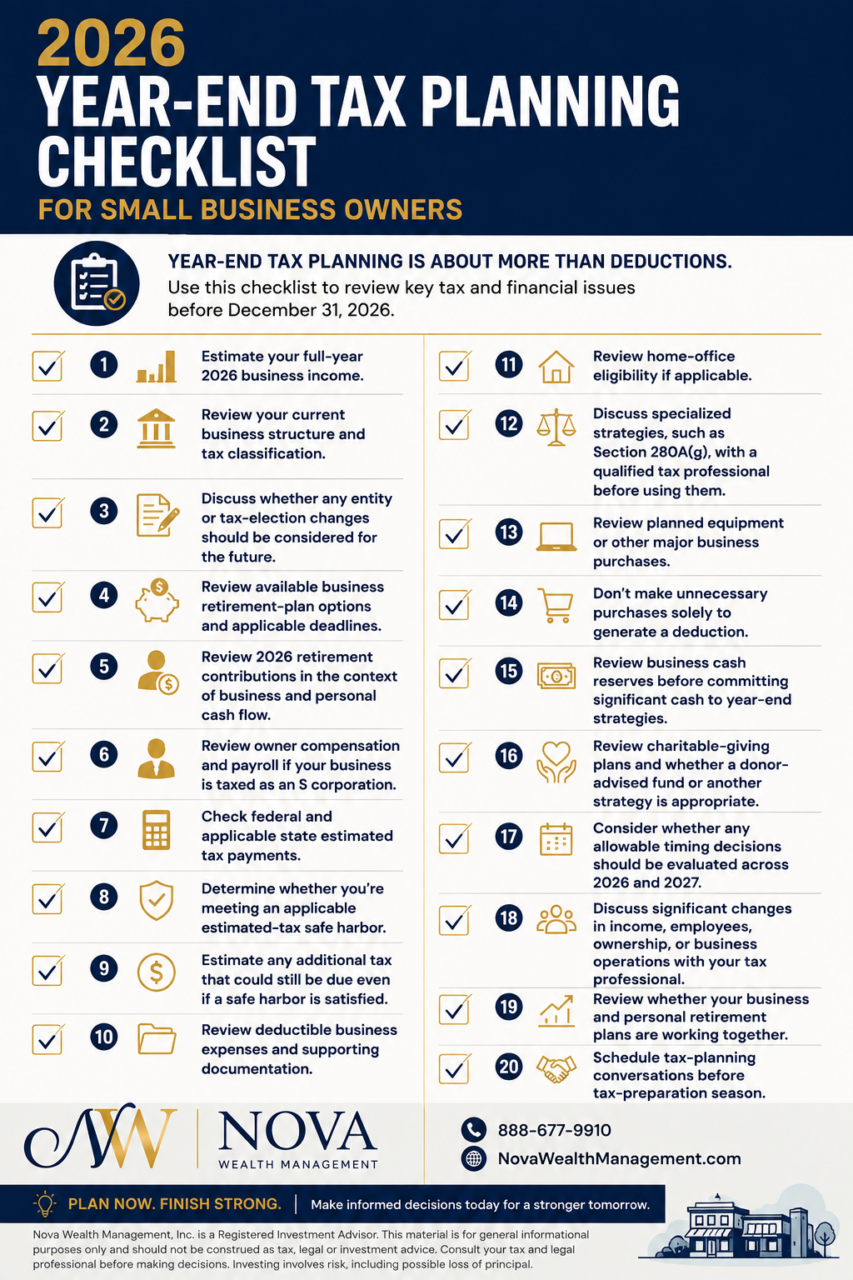
2026 Year-End Tax Planning Checklist for Small Business Owners
You don’t necessarily need to implement every strategy on this list.
Instead, use it to identify which conversations may be worth having before the end of the year.
- ☐ Estimate your full-year 2026 business income.
- ☐ Review your current business structure and tax classification.
- ☐ Discuss whether any entity or tax-election changes should be considered for the future.
- ☐ Review available business retirement-plan options and applicable deadlines.
- ☐ Review 2026 retirement contributions in the context of business and personal cash flow.
- ☐ Review owner compensation and payroll if your business is taxed as an S corporation.
- ☐ Check federal and applicable state estimated tax payments.
- ☐ Determine whether you’re meeting an applicable estimated-tax safe harbor.
- ☐ Estimate any additional tax that could still be due even if a safe harbor is satisfied.
- ☐ Review deductible business expenses and supporting documentation.
- ☐ Review home-office eligibility if applicable.
- ☐ Discuss specialized strategies, such as Section 280A(g), with a qualified tax professional before using them.
- ☐ Review planned equipment or other major business purchases.
- ☐ Don’t make unnecessary purchases solely to generate a deduction.
- ☐ Review business cash reserves before committing significant cash to year-end strategies.
- ☐ Review charitable-giving plans and whether a donor-advised fund or another strategy is appropriate.
- ☐ Consider whether any allowable timing decisions should be evaluated across 2026 and 2027.
- ☐ Discuss significant changes in income, employees, ownership, or business operations with your tax professional.
- ☐ Review whether your business and personal retirement plans are working together.
- ☐ If a business sale or succession may be approaching, begin planning well before the transaction.
- ☐ Schedule tax-planning conversations before tax-preparation season.
Five Questions to Ask Before Making Any Year-End Tax Decision
If the checklist feels overwhelming, narrow the conversation down to five questions:
- Would I make this financial decision even without the tax benefit?
- What does this do to my business and personal cash flow?
- Am I lowering taxes permanently, or simply changing when I may pay them?
- What other financial decisions does this affect?
- Have the appropriate tax, legal, and financial professionals reviewed the decision when needed?
Those questions can help move the conversation away from chasing deductions and toward making coordinated financial decisions.
The Bottom Line: Don’t Wait Until April to Start Tax Planning
Tax filing season is important.
But filing a tax return and planning for taxes are different activities.
For small business owners, some of the most important tax-related conversations may need to happen while the year is still open.
That can include reviewing business structure, retirement plans, compensation, estimated tax payments, charitable giving, deductions, business purchases, cash reserves, and longer-term plans for the company.
Not every strategy will apply to every business.
And reducing the current year’s tax bill shouldn’t automatically take priority over maintaining liquidity, saving for retirement, investing in the business, or pursuing other financial goals.
The goal is not necessarily to pay the least possible tax in 2026 at any cost.
The goal is to make informed financial decisions, understand their tax consequences, and coordinate those decisions with where you want the business—and your personal finances—to go next.
What Should Your Business Review Before the End of 2026?
Running a business can make financial planning more complicated because so many decisions overlap.
Taxes affect cash flow. Cash flow affects retirement savings. Business structure can affect compensation. Compensation can affect retirement-plan contributions. And eventually, decisions about the business itself may affect retirement and estate planning.
At Nova Wealth Management, we help business owners look at how these different pieces of their financial lives work together.
We do not replace your CPA, attorney, or other tax and legal professionals. Instead, financial planning can help coordinate decisions involving your business, investments, retirement, cash flow, and longer-term goals while working alongside the appropriate professionals.
If you’d like to discuss how your business fits within your broader financial plan, Schedule a Meeting with our team.
Phone: (239) 444-1794 (Florida) or (214) 764-9137 (Dallas)
This article was developed using concepts discussed in an August 24, 2026 Entrepreneur article by David Boice regarding year-end tax planning considerations for small business owners. Nova Wealth Management has expanded upon the topic for educational purposes and does not necessarily endorse every strategy, conclusion, or recommendation presented in the original article.
Disclosure: Nova Wealth Management, Inc. is a Registered Investment Advisor. This material is provided for general educational and informational purposes only and should not be construed as personalized investment, tax, accounting, or legal advice. Tax laws, retirement-plan rules, contribution limits, deadlines, deductions, credits, entity elections, and other requirements can change and may vary based on individual circumstances. The strategies discussed may not be appropriate or available for every business owner. Consult qualified tax, accounting, legal, and financial professionals regarding your specific circumstances before implementing a strategy. Investing involves risk, including the potential loss of principal. Past performance is not indicative of future results.




No Comments